Turkish Citizenship: Real Estate vs Bank Deposit—Legal and Tax
Under Turkish Citizenship Law No. 5901 (Article 12), foreign investors evaluate Citizenship via Real Estate vs Bank Deposit options, focusing on eligibility and potential outcomes. The choice determines required documentation, processing timelines, and how assets are reported. A thorough early assessment helps align expectations with legal realities and investment goals.
Beyond eligibility, the real estate route and the deposit route involve distinct legal frameworks, administrative procedures, tax implications, and financial trade-offs. Each path requires careful consideration of monitoring duties, compliance steps, and long-term effects on investment strategy. Investors benefit from a formal review to ensure a compliant, informed decision.
Below is a detailed analytical breakdown comparing both options under current 2026 regulations.
1. Key Legal & Procedural Differences
Statutory Investment Thresholds
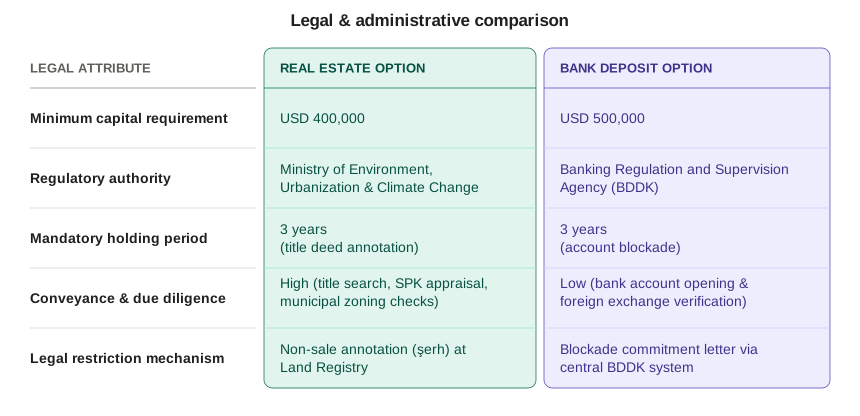
Real Estate: Requires acquiring one or multiple properties with an aggregate declared value of at least USD 400,000.
Bank Deposit: Requires depositing a minimum of USD 500,000 (or equivalent foreign currency) into an operating bank in Turkey.
Regulatory Supervision & Certification
Real Estate: Inspected and certified by the Ministry of Environment, Urbanization and Climate Change, which verifies the official SPK valuation report, title deed transfer, and Central Bank Foreign Currency Purchase Certificate (Döviz Alım Belgesi – DAB) to issue the Certificate of Conformity.
Bank Deposit: Inspected and certified by the Banking Regulation and Supervision Agency (BDDK), which verifies that funds are held in a personal account under a 3-year non-withdrawal commitment.
Title Encumbrance vs. Cash Blockade
Real Estate: Ownership transfers to the buyer immediately, but an official 3-year non-sale annotation (3 year satılamaz şerhi) is registered on the land registry title. You own the physical asset and can occupy or lease it immediately.
Bank Deposit: The principal sum ($500,000) is locked in a bank account for 3 years. While the principal cannot be withdrawn, interest, dividends, or profit shares earned during the 3 years can be freely accessed or withdrawn.
2. Tax & Fee Breakdown
The financial obligations associated with acquiring and holding each investment type differ significantly:
Upfront Transaction Costs
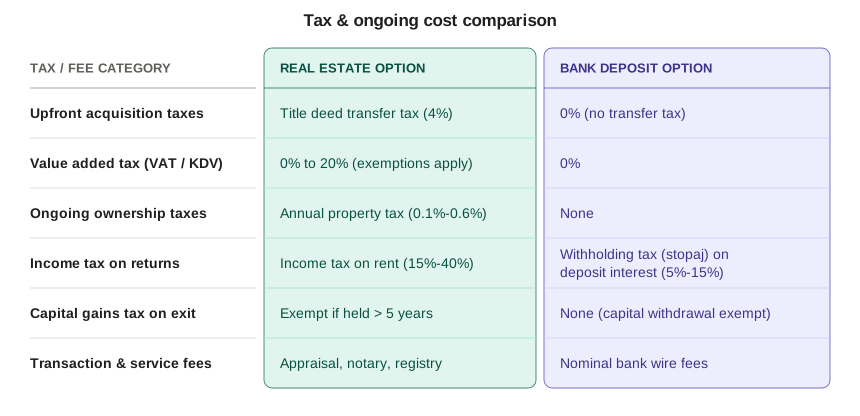
Real Estate: Subject to a 4% Title Deed Transfer Tax (Tapu Harcı) calculated on the declared sale value (typically split 2% buyer / 2% seller, though negotiable), plus SPK appraisal fees, notary expenses, and translation costs. VAT (KDV) ranges from 1% to 20%, though first-time foreign buyers purchasing from developers are often eligible for a VAT Exemption under strict legal conditions.
Bank Deposit: Incurs zero title transfer taxes or VAT. The primary transaction cost consists of bank incoming wire fees and currency conversion spreads.
Tax on Yield & Returns
Real Estate (Rental Income): Rental income generated from property is subject to Turkish Personal Income Tax at progressive rates ranging from 15% to 40%, subject to annual exemption allowances and deductible expenses.
Bank Deposit (Interest Income): Interest earned on Lira or foreign currency deposits is subject to bank withholding tax (Stopaj), which is automatically deducted at the source by the bank (typically ranging between 5% and 15% depending on maturity and currency structure).
Capital Gains Tax upon Exit (After 3 Years)
Real Estate: If you sell the property after the mandatory 3-year citizenship holding period, but before completing 5 full years of ownership, any capital gain over the inflation-adjusted cost basis is subject to Personal Income Tax (15%–40%). If held for more than 5 years, the capital gain is 100% tax-exempt.
Bank Deposit: Withdrawing your principal deposit after the 3-year blockade expires triggers no capital gains tax.
3. Financial & Risk Trajectory Simulation
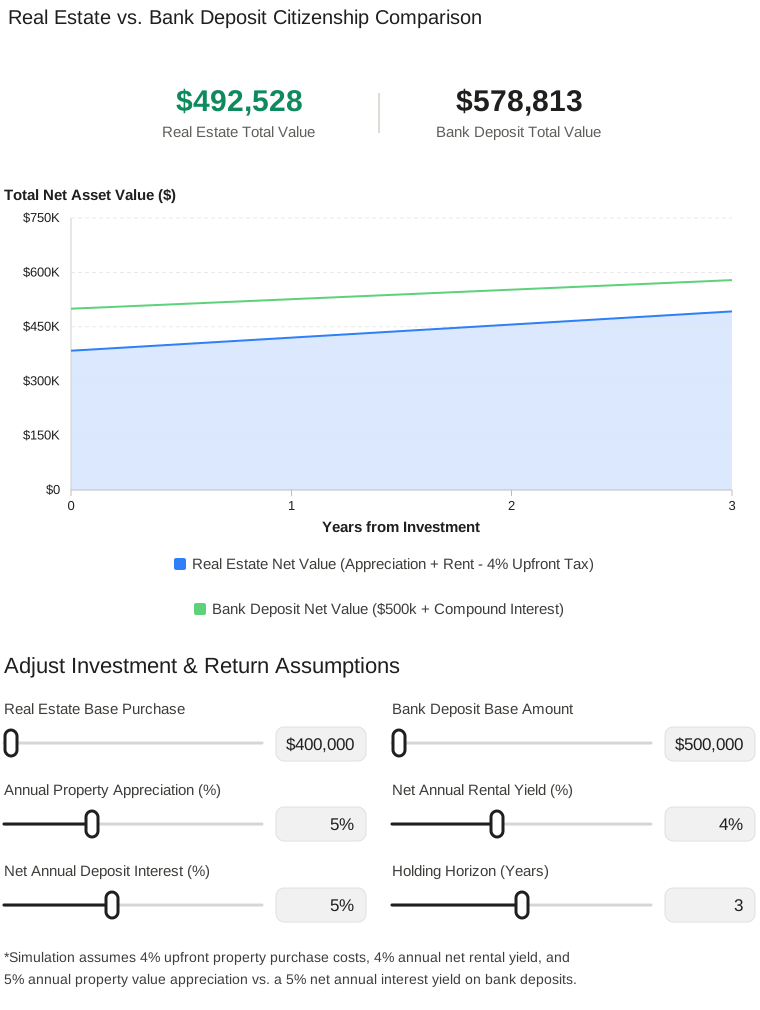
The decision between real estate and bank deposits involves choosing between capital appreciation with ongoing management versus liquidity, fixed returns, and zero maintenance.
The dynamic 3-year comparative model below illustrates the net capital trajectories of both options:
4. Summary: Which Route Fits Your Strategy?
Choose Real Estate ($400,000 minimum) if: You seek a lower entry threshold, want tangible real estate in growing urban centers (like Istanbul or Antalya), desire ongoing passive rental income, and aim to hedge against foreign currency inflation through property value appreciation.
Choose Bank Deposit ($500,000 minimum) if: You prefer a straightforward, rapid application without property management, title searches, municipal zoning audits, or transaction taxes. It offers liquid capital that can be withdrawn in full immediately after 3 years.
FAQs About Legal & Tax Differences Between Real Estate and Bank Deposit Routes
What are the statutory minimum capital thresholds for the Real Estate vs. Bank Deposit routes?
Citizenship via Real Estate vs Bank Deposit under Turkish Law No. 5901 (Article 12) outlines two routes.
The Real Estate route requires USD 400,000 purchase, verified by an SPK valuation and recorded at the Land Registry.
The Bank Deposit route requires USD 500,000 deposited in a Turkish bank under a 3-year non-withdrawal blockade.
Which government ministries supervise and issue the Certificate of Conformity for each route?
For the real estate path, the Ministry of Environment, Urbanization and Climate Change reviews the title deed, valuation report, and Central Bank Foreign Currency Purchase Certificate (DAB) to issue the Certificate of Conformity (Uygunluk Belgesi). For the bank deposit path, the Banking Regulation and Supervision Agency (BDDK) audits the deposit transaction and places the official 3-year blockade notice to issue the compliance certificate.
What upfront taxes and administrative transaction fees apply to each investment option?
Real Estate: Incurs a 4% Title Deed Transfer Tax (Tapu Harcı) calculated on the declared sale value (typically split 2% buyer / 2% seller), plus SPK appraisal fees, notary costs, and potential Value Added Tax (VAT / KDV) ranging from 1% to 20% (unless qualifying for a foreign investor VAT exemption).
Bank Deposit: Incurs 0% transfer tax, zero VAT, and no notary conveyance fees. Transaction costs are limited to standard incoming bank wire fees, intermediary bank commissions, and foreign exchange conversion spreads.
How are the ongoing yields and returns taxed under each investment route?
Real Estate (Rental Income): Rental income generated from leasing the property during or after the mandatory 3-year holding period is subject to progressive Turkish Personal Income Tax ranging from 15% to 40%, subject to annual exemption allowances and deductible maintenance expenses.
Bank Deposit (Interest / Profit Share): Interest earned on Lira or foreign currency deposits (or profit-share yields in Islamic participation banks) is subject to bank withholding tax (Stopaj), which is automatically deducted at source by the commercial bank (typically 5% to 15% depending on account currency and term structure).
How does Capital Gains Tax apply when exiting the investment after the 3-year holding period?
Real Estate: If you sell the property after the 3-year citizenship restriction expires but before completing 5 full years of ownership, any capital gain over the inflation-adjusted cost basis is subject to Personal Income Tax (15%–40%). If held for more than 5 full years, the capital gain upon resale is 100% tax-exempt.
Bank Deposit: Unblocking and withdrawing your principal cash deposit ($500,000) after the 3-year BDDK restriction expires triggers zero capital gains tax or exit penalties.
Does choosing either route automatically make me a Turkish tax resident?
No. Obtaining Turkish citizenship through real estate or bank deposits does not automatically establish tax residency. Under Turkish Income Tax Law No. 193, an individual becomes a Full Tax Resident (taxed on worldwide income) only if they establish a permanent legal residence or spend more than 183 days within a calendar year inside Turkey. If you remain physically present in Turkey for fewer than 183 days, you are classified as a Limited Taxpayer, liable solely for Turkish-source income (such as local real estate rental yields).
Legalixa has been Istanbul’s leading provider of citizenship by investment law services, having successfully obtained more than 560 passports by investment for our clients.
Choosing between the real estate acquisition route and the bank deposit option for Turkish citizenship requires a thorough analysis of your long-term wealth strategy, tax exposure, and family mobility goals. Navigating complex Central Bank foreign exchange conversions, title deed encumbrance audits, Banking Regulation and Supervision Agency (BDDK) compliance certificates, and international tax treaties demands experienced legal oversight. At Legalixa Law Firm, our specialized Istanbul-based citizenship lawyers in Turkey provide end-to-end legal representation to protect your foreign capital and streamline your naturalization process under Turkish Citizenship Law No. 5901.
Whether you require comprehensive real estate due diligence, remote Power of Attorney execution, bank deposit oversight, or personalized cross-border tax advice, our team is equipped to assist you across every stage of the application. Established in 1992, Legalixa Law Firm operates as a full-service practice delivering tailored legal assistance in English, Chinese, Farsi, and Russian. Contact Legalixa Law Firm today to schedule a consultation with our senior immigration and tax attorneys and initiate your Turkish citizenship journey with full legal confidence.