Address:
Uskudar Icerenkoy Yolu Cad. No:21
Atasehir, Istanbul 34752
TURKIYE
Working Hours:
Monday - Friday: 9:00 - 18:30
Weekends: Closed

Address:
Uskudar Icerenkoy Yolu Cad. No:21
Atasehir, Istanbul 34752
TURKIYE
Working Hours:
Monday - Friday: 9:00 - 18:30
Weekends: Closed

Securing dual citizenship has transformed from a luxury into an essential strategic risk management tool for global investors, high-net-worth individuals, and business leaders seeking economic mobility. Among the various pathways available within the Republic of Turkey’s naturalization program, Turkish citizenship by government bonds stands out as an extraordinarily stable, secure, and highly liquid sovereign option. Unlike real estate acquisitions that involve complex property management, fluctuating valuation assessments, and potential physical asset depreciation, sovereign bond acquisitions provide direct exposure to state-backed debt instruments with fixed holding requirements and minimal administrative overhead.
At Legalixa Law Firm, our dedicated team of multi-lingual attorneys has provided comprehensive legal counsel to international clients navigating naturalization, investment law, and cross-border wealth management since 1992. Operating from our central headquarters in Istanbul, Turkey, our seasoned Istanbul citizenship lawyers combine decades of corporate law experience with deep regulatory insight into Turkish investment frameworks. We seamlessly assist high-net-worth individuals in English, Chinese, Farsi, Russian, and Turkish, ensuring that every financial transfer, compliance verification, and residence filing strictly adheres to statutory mandates.
Navigating the financial and procedural intricacies of obtaining Turkish citizenship by government bonds requires a thorough understanding of financial regulations, currency conversion mechanics, and administrative processes overseen by the Ministry of Treasury and Finance.
Table of Contents
The statutory foundation governing naturalization via economic capital contribution is anchored primarily within Article 12 of Turkish Citizenship Law No. 5901. Under this legislation, the Turkish government established exceptional naturalization pathways designed to attract direct foreign capital, stabilize national development funds, and foster international investment relationships. Supplementary presidential decrees further refined these pathways, formally recognizing government debt instruments alongside real estate, fixed capital, and commercial banking options.
The legal mechanism for Turkish citizenship by government bonds enables non-Turkish investors to apply for full naturalization by acquiring public debt instruments issued by the Ministry of Treasury and Finance. The legislative framework establishes a fixed capital commitment threshold, currently set at a minimum valuation of USD 500,000 or its equivalent in convertible foreign currency. Crucially, the law dictates that these state bonds must be retained continuously for a minimum period of three years without being encumbered, transferred, or liquidated.
Enrolling under Turkish Citizenship Law No. 5901 through sovereign debt ensures a direct regulatory relationship with state authorities rather than commercial third parties. Foreign applicants are granting capital directly to sovereign instruments, ensuring maximum state backing while gaining access to all civil rights associated with holding a Turkish passport. Because these regulatory requirements undergo periodic updates, retaining qualified citizenship lawyers in Turkey is crucial to maintaining compliance throughout the mandatory three-year holding period.
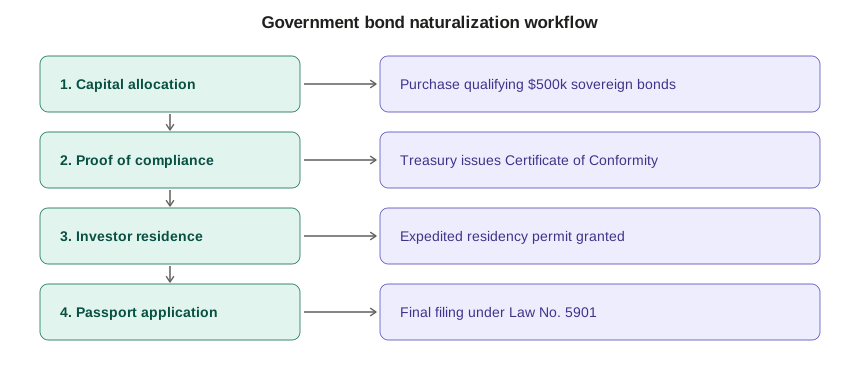
To successfully qualify for naturalization through state debt instruments, international investors must meet strict statutory criteria set by the Ministry of Treasury and Finance and the Directorate General of Migration Management. Understanding these prerequisites is vital prior to initiating foreign exchange transfers or executing security transactions within Turkish capital markets.
The primary parameter governing Turkish citizenship by government bonds is the minimum financial threshold of USD 500,000. Investors can fund this acquisition in foreign currencies (such as USD, EUR, or GBP), which are subsequently processed through authorized financial institutions under Central Bank FX regulations. The financial commitment must equal or exceed the USD 500,000 threshold on the official date of purchase, verified via exchange transaction records and banking receipts.
Under the governing provisions of Turkish citizenship by investment laws, the acquired bonds must remain under a strict three-year non-disposal restriction. During this statutory lock-in period, the foreign investor retains full title to the underlying debt securities and remains entitled to collect regular coupon payments or yield distributions. However, the principal securities cannot be sold, pledged as collateral, transferred, or prematurely redeemed prior to the exact completion of the three-year anniversary.
A foundational requirement within the legal process is obtaining an official Certificate of Conformity (Uygunluk Belgesi). This document is issued directly by the Ministry of Treasury and Finance following a careful audit of the bond acquisition, bank clearing statements, and custody account blocking orders. The Certificate of Conformity serves as the legal proof required by civil status authorities to process the Turkish citizenship application.

When evaluating options under Turkish citizenship by investment, foreign investors must carefully compare the financial, legal, and operational nuances of each qualifying pathway. While real estate remains a widely discussed option, purchasing state bonds offers unique strategic advantages that appeal specifically to institutional figures, family offices, and conservative investors.
| Investment Route | Minimum Requirement | Primary Asset Class | Risk & Operational Profile |
| Government Bonds | USD 500,000 | State Debt Instruments | High capital security, zero asset management, fixed holding period. |
| Real Estate | USD 400,000 | Residential/Commercial Property | Property maintenance, tenant management, valuation variances, liquidity lag. |
| Bank Deposit | USD 500,000 | Commercial Bank Cash Deposit | Simple execution, potential interest withholding taxes depending on structure. |
| Fixed Capital Investment | USD 500,000 | Commercial Enterprise / Equity | Operational risk, business overhead, market execution complexity. |
Selecting Turkish citizenship by government bonds eliminates many of the friction points common to tangible property investments. Real estate transactions frequently require independent property valuation reports (expertiz), title deed transfers at land registry offices, ongoing municipal tax filings, maintenance costs, and potential tenant management issues. Conversely, purchasing government bonds requires no physical inspections, structural maintenance, or real estate market risks.
Sovereign bonds offer streamlined exit options after the mandatory three-year holding period. Liquidating real estate after three years requires sourcing buyers, negotiating commercial terms, paying broker fees, and enduring unpredictable closing timelines. Government bonds, in contrast, can be liquidated efficiently through established capital markets or held until maturity, providing clear capital recovery options backed by the sovereign state.

Completing a Turkish citizenship application via government bonds requires methodical execution across corporate, legal, and financial domains. Working alongside legal counsel ensures every document, financial transfer, and regulatory filing complies with Turkish law.
The procedure begins with preparing core identification and civil documents, including valid international passports, birth certificates, marriage certificates, and utility bills verifying residential address. These documents must be duly legalised via Apostille or through Turkish diplomatic missions abroad, accompanied by sworn Turkish translations. To streamline execution without requiring the client’s continuous physical presence in Turkey, investors typically issue a limited Power of Attorney (POA) to our Istanbul citizenship lawyers at a Turkish embassy or local notary.
Armed with a Power of Attorney, legal counsel secures a Turkish Potential Tax Identification Number from the tax authority. Next, counsel assists the client in opening an institutional bank account and investment custody account at a major Turkish financial institution. This custody account holds the qualifying bond instruments under the investor’s explicit name throughout the holding period.
The foreign investment capital (USD 500,000 or foreign currency equivalent) is wired from the investor’s overseas account directly into their personalized bank account in Turkey. Under Central Bank guidelines, foreign currencies must be converted via an authorized bank, which issues a mandatory Foreign Exchange Purchase Certificate (Döviz Alım Belgesi) confirming the transaction details.
With funds credited, the investor purchases qualifying government debt securities issued by the Ministry of Treasury and Finance. Once purchased, an official blocking restriction (şerh) is placed on the securities in the investor’s custody account, restricting sale or transfer for three years.
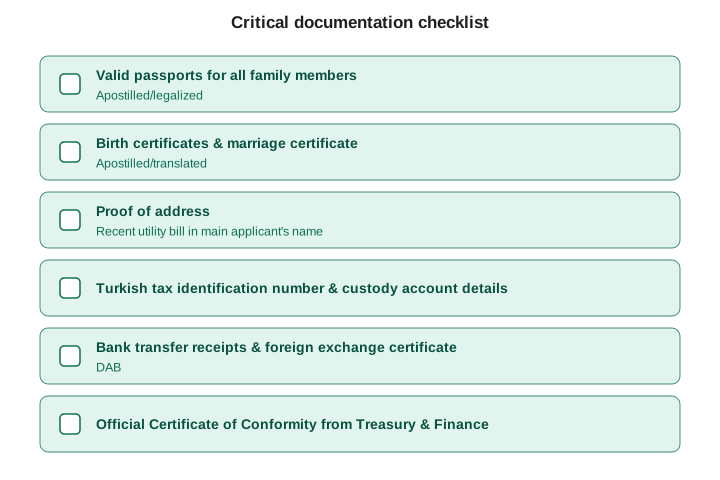
Following the custody lock, an application is submitted to the Ministry of Treasury and Finance to verify the transaction. The Ministry audits the bank statements, clearing records, and central registry entries to confirm compliance with Turkish Citizenship Law No. 5901. Upon successful review, the Ministry issues the official Certificate of Conformity.
Obtaining a Certificate of Conformity grants the investor the legal right to apply for a specialized Investor Residence Permit under Article 31(j) of Law No. 6458. This residence permit is an expedited prerequisite designed exclusively for foreign investors. Unlike standard short-term residency categories, it does not require a minimum physical stay in Turkey.
Once the investor residence permit is granted, the final Turkish citizenship application dossier is submitted to the Directorate General of Population and Citizenship Affairs. The file undergoes standard administrative reviews, background checks, and security clearances conducted by national security agencies. Upon presidential decree approval, the main applicant and eligible family members are issued official Turkish identity cards and biometric passports.





In addition to fulfilling basic legal requirements, investors pursuing Turkish citizenship by government bonds must evaluate financial parameters including yield structures, taxation rules, and currency conversion mechanics.
Government bonds issued by the Republic of Turkey offer structured yield payments, distributed as semi-annual or annual coupon payments depending on the specific bond issuance. Unlike bank deposits that may carry variable interest rates, fixed-income government bonds allow investors to calculate their returns over the three-year commitment period.

From a tax management perspective, holding state debt instruments offers attractive tax benefits. Income derived from coupon payments and capital gains on state-issued debt instruments is generally exempt from standard personal income tax regimes for non-residents or subject to favorable withholding rates under double-taxation avoidance treaties. Consulting seasoned citizenship lawyers in Turkey ensures your overall investment architecture is optimized for your home country tax obligations.
A major strength of Turkish citizenship by investment is its broad family coverage. A single qualifying $500,000 bond investment covers:
Children under 18 receive full citizenship along with their parents. Dependent adult children or elderly parents require separate qualifying applications, though specialized family residency permits remain accessible for extended family members.

The minimum required investment threshold for Turkish citizenship by government bonds is USD 500,000 or its foreign currency equivalent. This capital must be committed to state debt instruments issued by the Ministry of Treasury and Finance and held continuously for at least three years.
No, under Turkish Citizenship Law No. 5901, the bonds cannot be sold, transferred, or pledged as collateral during the three-year period. An official restriction is recorded in your custody account. Violating this holding requirement results in the immediate revocation of your Certificate of Conformity and naturalization status.
No, the legal process for acquiring Turkish citizenship by government bonds does not impose any minimum physical residency requirements before, during, or after passport issuance. Investors and their families can complete most steps remotely through legal power of attorney, visiting Turkey only for final biometric recording if preferred.
The entire process from capital transfer to receiving your Turkish passport typically spans between 3 to 6 months. Initial account setup and bond purchasing take 1 to 3 weeks, followed by Treasury certificate issuance within roughly 15 days. Final background checks and administrative processing complete the timeline.
Yes, a single qualifying bond investment of USD 500,000 grants full naturalization rights to the main applicant, their legally recognized spouse, and all minor children under 18 years old. All family members receive standard Turkish passports and identity documents simultaneously.
While real estate requires a lower minimum threshold ($400,000 vs $500,000), government bonds eliminate physical asset maintenance, property tax filings, tenant management, and property valuation risks. Government bonds offer predictable yield returns and straightforward market exit options after the mandatory three-year holding period.
Legalixa has been Istanbul’s leading provider of citizenship by investment law services, having successfully obtained more than 560 passports by investment for our clients.
Selcuk Akkas, Attorney at Law, Patent & Trademark Attorney & Mediator
Navigating foreign investment frameworks and international naturalization laws requires expert legal counsel. At Legalixa Law Firm, our experienced team of Istanbul citizenship lawyers provides end-to-end representation for international investors seeking Turkish citizenship by government bonds. Since 1992, our firm has successfully guided cross-border investors, corporate leaders, and international families through complex regulatory procedures under Turkish Citizenship Law No. 5901. We manage every stage of your investment journey—from initial tax registration and custody account setup to foreign exchange compliance, Treasury attestation, residence permit filings, and final passport delivery.
Our full-service Istanbul legal team offers comprehensive counsel in English, Chinese, Farsi, Russian, and Turkish, ensuring clear communication and absolute transparency throughout your naturalization journey. Whether you require guidance on cross-border tax planning, capital structuring, or multi-jurisdictional estate management, Legalixa Law Firm combines deep local knowledge with international legal standards. Contact our dedicated citizenship lawyers in Turkey today to schedule an initial consultation and secure your family’s global future through Turkey’s sovereign bond program.